
Kathryn Reid’s first TikTok video reached 1.3 million views and helped turn her farm-inspired jewellery into a global business. In this episode of the Jewellers Academy podcast, Kathryn joins Kelly Twigg to share how she found her way into jewellery making, discovered wax carving and created her distinctive animal nose rings. They talk about going viral, managing demand, building a loyal audience and adapting when tariffs and rising metal prices changed the business. Kathryn also explains why she still makes every piece herself and how the animals, stories and memories from her family farm continue to inspire her work.

Listen now
Want to listen on the go? Find the podcast here:
What happens when you combine a family farm, a love of wax carving, a highly distinctive jewellery collection and a TikTok video that reaches 1.3 million people? For jewellery designer Kathryn Reid, it became the beginning of a global jewellery business.
In this episode of the Jewellers Academy podcast, host Kelly Twigg is joined by Kathryn Reid, the award-winning designer behind Kathryn Reid Jewellery. Kathryn is best known for her sculptural animal nose rings and farm-inspired designs, which are handmade in her studio on her family’s farm in Northern Ireland.
Kathryn shares how she found her way into jewellery making, why she nearly left university, how her first TikTok video went viral and what she has learned from building a successful jewellery business with customers around the world.
They also talk about wax carving, creating jewellery with meaning, responding to changing demand and why Kathryn has chosen to keep making every piece herself.
Finding an unexpected route into jewellery making
Kathryn did not grow up knowing that she wanted to become a jeweller.
Art had always been her favourite subject at school, and she initially planned to study photography at university. After being rejected from all five photography courses she applied for, a family member suggested that she complete an art and design foundation course instead.
The course gave Kathryn the opportunity to explore photography, fashion, fine art, ceramics, printmaking and a wide range of materials. Although she enjoyed fashion design, she quickly realised that working with fabric was not for her. She was much more interested in harder materials such as glass, wood, wire and shells. A tutor suggested that jewellery might be the right direction for her, and Kathryn went on to study jewellery and silversmithing at Edinburgh College of Art.
It was not an easy beginning because her foundation qualification allowed her to enter directly into the second year of the degree, Kathryn joined a class of students who had already spent a year learning jewellery-making and silversmithing techniques.
Kathryn had never made jewellery before.
She often felt as though she was at the bottom of the class and admits that there was a point when she considered dropping out. However, everything changed during her final year, when she had more freedom to choose her inspiration, explore her preferred techniques and develop her own creative direction.
Kathryn specialised in wax carving, created a collection inspired by her experiences of growing up on a farm and graduated with a first-class degree.
Building a jewellery business alongside other jobs
After university, Kathryn knew that she wanted to travel before settling into a long-term career.
She returned home to Northern Ireland and spent several years combining different jobs. She worked in retail, coached sport and continued making jewellery alongside everything else.
In January 2020, Kathryn began travelling. She spent a month in Thailand and six months in New Zealand before the pandemic brought her plans to an earlier end than expected. When she returned home in September 2020, she realised how much she had missed being creative. Kathryn decided that it was time to give her jewellery business a proper chance. Within her first week back, she created a TikTok account and shared a video showing how she made her cow ear tag earrings.
That first video received approximately 1.3 million views.
Kathryn continued creating videos, her audience grew and more jewellery orders began to arrive. When the Topshop store where she worked closed and Kathryn was made redundant in February 2021, she decided to take her jewellery business full-time. What might initially have felt like another setback became the push she needed to commit fully to the business.
How the family farm inspired Kathryn’s signature jewellery
Kathryn’s jewellery is deeply connected to the farm where she grew up.
Both sets of her grandparents were farmers, and her own family continues that tradition. The farm is not simply a location for Kathryn’s studio; it is the source of the memories, stories, animals and experiences that shape her work.
One of the most meaningful pieces Kathryn created during university was inspired by Buddy, her childhood dog, who died during the final year of her degree. Kathryn made a small sculptural medal featuring Buddy’s nose on one side and his basket, with his blanket pulled out, on the other. It was a personal way to remember him and keep him close.
That piece eventually helped inspire Kathryn’s now-famous animal nose rings. Rings are Kathryn’s favourite type of jewellery to wear, so she combined the sculptural animal noses with a wearable ring design. The name was also a playful reference to the metal nose rings worn by bulls.
Each animal in the collection has its own connection to Kathryn’s life. The sheep nose ring was inspired by Finbar, a much-loved pet lamb who was treated more like another family dog and even spent time inside the house. Her horse nose ring connects to her grandfather’s history of breeding and showing Clydesdale horses, a tradition continued by Kathryn’s parents.
The designs resonate with customers because they are not simply representations of animals. They carry stories of family, home, memory and the relationships people have with the animals they love. For customers who have lost a beloved animal, the jewellery can also become a way of remembering them and carrying that connection every day.
Why wax carving became Kathryn’s signature technique
Kathryn was introduced to wax carving during her first year at Edinburgh College of Art and quickly fell in love with the technique.
She enjoyed carving more broadly too, experimenting with cow bone and horn and creating textures inspired by details such as tractor tyre treads. Wax carving allowed her to translate those interests into sculptural jewellery that could later be cast in silver or gold.
It is particularly well suited to Kathryn’s animal nose rings because it enables her to create the depth, texture and three-dimensional detail that would be extremely difficult to produce using sheet metal or wire.
Wax carving remains at the centre of Kathryn’s jewellery practice, although she is beginning to combine it with other skills. She reveals in the episode that one of her forthcoming designs will incorporate a gemstone, giving customers something new to look forward to.
She would also like to develop her hand-engraving skills in the future. Kathryn already uses a small hand engraver to restore texture to cast pieces after filing and finishing, but she would love to explore the technique in greater depth.
Going viral and learning to manage demand
Kathryn’s cow ear tag earrings helped her find an audience on TikTok, while her animal nose rings became particularly popular on Instagram.
As the designs reached more people, Kathryn’s audience expanded from being predominantly based in the UK and Ireland to becoming truly international. She now sends jewellery to customers around the world, with particularly strong audiences in the United States and Germany.
That growth also created a new challenge: how could one jeweller keep up with the demand for handmade pieces?
Kathryn initially managed demand through limited nose ring restocks. When she launched her first cow nose ring, she invested in a mould and ten silver castings. As a new and unusual design, she had no way of knowing how customers would respond. Those first ten rings took around two weeks to sell.
Kathryn would finish, resize, oxidise and polish each order while preparing the next collection of castings. As her following grew, restocks began selling much more quickly, sometimes within minutes. The limited releases helped Kathryn control the number of orders she accepted, but they also created significant peaks of work and encouraged customers to buy quickly before the designs disappeared.
Changes to international trade and US tariffs later contributed to a drop in sales from Kathryn’s largest overseas market. For the first time, one of her nose ring restocks did not sell out. Although that initially felt worrying, it led to a more sustainable way of working. Kathryn gradually moved away from limited restocks and began keeping more of the nose ring collection available throughout the year. Customers no longer need to panic-buy, orders arrive more steadily and Kathryn has less pressure to complete a large batch at once.
It is a valuable reminder that an unexpected business challenge can sometimes lead to a model that works better for both the maker and the customer.
Why Kathryn still makes every piece herself
When demand for the nose rings began increasing, Kathryn explored whether parts of the making process could be outsourced.
She approached several workshops and had samples produced, but the finished pieces did not meet the standard she wanted for her work. Kathryn made the decision that every piece of Kathryn Reid Jewellery would continue to be finished by her own hands.
That choice naturally limits how much jewellery she can produce, but it is also an important part of the brand. Customers know who made their jewellery and understand the personal story behind it.
For Kathryn, the making is also the part of the business she loves most.
She enjoys creating social media content, taking photographs and editing videos, but the practical work remains at the heart of her working day. After beginning the morning with emails, ordering materials and other laptop tasks, she travels to the farm, greets her three dogs and spends the rest of the day making, carving wax, finishing jewellery or packing orders.
Creating your own definition of business growth
Kathryn has considered hiring a team or opening a physical shop, but she has realised that neither is necessarily what she wants.
She enjoys making every piece herself and is happy with the size and structure of the business she has created. That does not mean she has stopped dreaming about what could come next. One of Kathryn’s ambitions is to hold an international pop-up shop or exhibition, potentially in the United States or Germany, where she already has a significant following. She would love to give overseas customers the opportunity to see the jewellery in person and to meet some of the people who have supported her business online.
Her story is an important example of how growth does not always have to mean employing a large team, opening multiple shops or stepping away from the making process.
A successful jewellery business can be designed around the type of work and life its founder genuinely wants.
Adapting to the challenges of running a jewellery business
Kathryn is open about the fact that building a jewellery business has not been a completely smooth journey.
In just a few years, she has navigated the pandemic, Brexit, international tariffs and sharp increases in precious metal prices.
At the end of a particularly difficult year, Kathryn attended a Jewellers Academy webinar led by Jessica Rose about rising precious metal costs. Jess shared that throughout her career in the jewellery industry, there had always been another hurdle to overcome. The specific challenge might change, but jewellers find ways to learn, adapt and keep going. That advice helped Kathryn approach the new year with a more positive mindset. She now tries to view difficult periods as learning opportunities that will better equip her for whatever comes next. She is also a firm believer in celebrating the good days and recognising the smaller wins along the way.
Award-winning jewellery inspired by home
Kathryn’s distinctive designs have also received recognition from the wider jewellery industry.
After several years of seeing customers connect with her nose rings, Kathryn decided that her work might finally be ready for an industry competition. She entered her sheep nose ring and went on to receive both a bronze award in the Modellers category and a silver award in the Ready-to-Wear category at the Goldsmiths’ Craftsmanship and Design Awards.
Attending the awards ceremony at Goldsmiths’ Hall and being surrounded by highly skilled jewellers was a surreal experience for Kathryn, who describes herself as feeling like a country girl in the big city. The awards provided valuable recognition for jewellery rooted in her own memories, identity and experiences of home.
Kathryn’s advice for aspiring jewellers
Kathryn encourages anyone interested in becoming a jeweller to explore all the different routes available.
University was the only path she knew about when she was 18, but there are now many ways to learn jewellery making, including short courses, apprenticeships and specialist online training (including from Jewellers Academy).
The right route will depend on the skills you want to learn, the type of jewellery you hope to make and the way you learn best.
Kathryn also recommends looking for jewellery-specific business support.
Most importantly, Kathryn’s story shows the value of finding the materials, techniques and subject matter that genuinely excite you.
The work that once helped her flourish during the final year of university has now become the foundation of an internationally recognised jewellery brand.
Listen to the episode
Listen to the full episode of the Jewellers Academy podcast to hear Kathryn Reid talk about:
Finding her way into jewellery making after initially applying to study photography
Starting university with no previous jewellery-making experience
Discovering wax carving and developing her signature sculptural style
The TikTok video that received 1.3 million views
Turning her jewellery side business into a full-time career
Creating her animal nose rings and the personal stories behind them
Managing viral demand and changing her restock model
Keeping every piece handmade
Adapting to tariffs, rising metal prices and other business challenges
Winning prestigious jewellery industry awards
Her advice for anyone considering a career in jewellery making
Her ambitions for the future of Kathryn Reid Jewellery
Whether you are learning to make jewellery, developing your own signature collection or wondering how to grow a jewellery business without losing the part you love, Kathryn’s story is full of creativity, honesty and encouragement.
Listen to the episode now on the Jewellers Academy podcast.
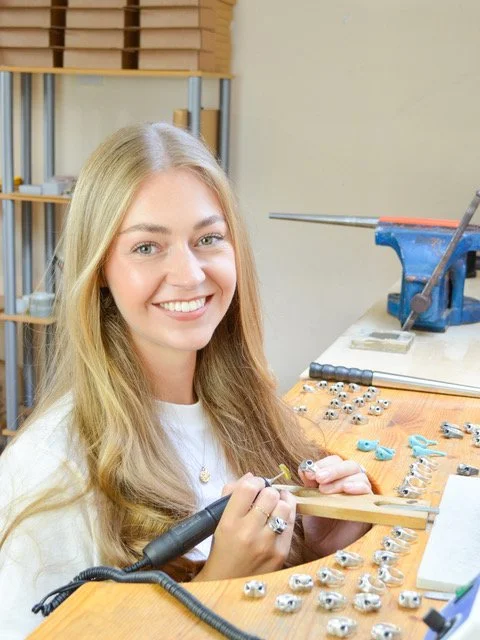
about kathryn
Kathryn studied at Edinburgh College of Art, part of the University of Edinburgh and graduated in 2018 with a First Class Honours Degree in Jewellery & Silversmithing. After graduating she returned home to the North Coast of Northern Ireland and set up her small business on the family farm. Her work is hugely inspired by the wee place she calls ‘home,’ taking inspiration from the farm where she grew up on the stunning North Coast of Northern Ireland.
Ever since 2018 Kathryn’s small business has continued to grow. In 2021, she began working full time as Kathryn Reid Jewellery after her pieces gained significant attention through social media. Ever since then she has continued to grow, selling her pieces exclusively on her website and shipping them globally. She specialises in the detailed skill of wax carving, creating miniature wearable sculptures full of story and meaning.